Build Your Enterprise AI Strategy With Microsoft Fabric

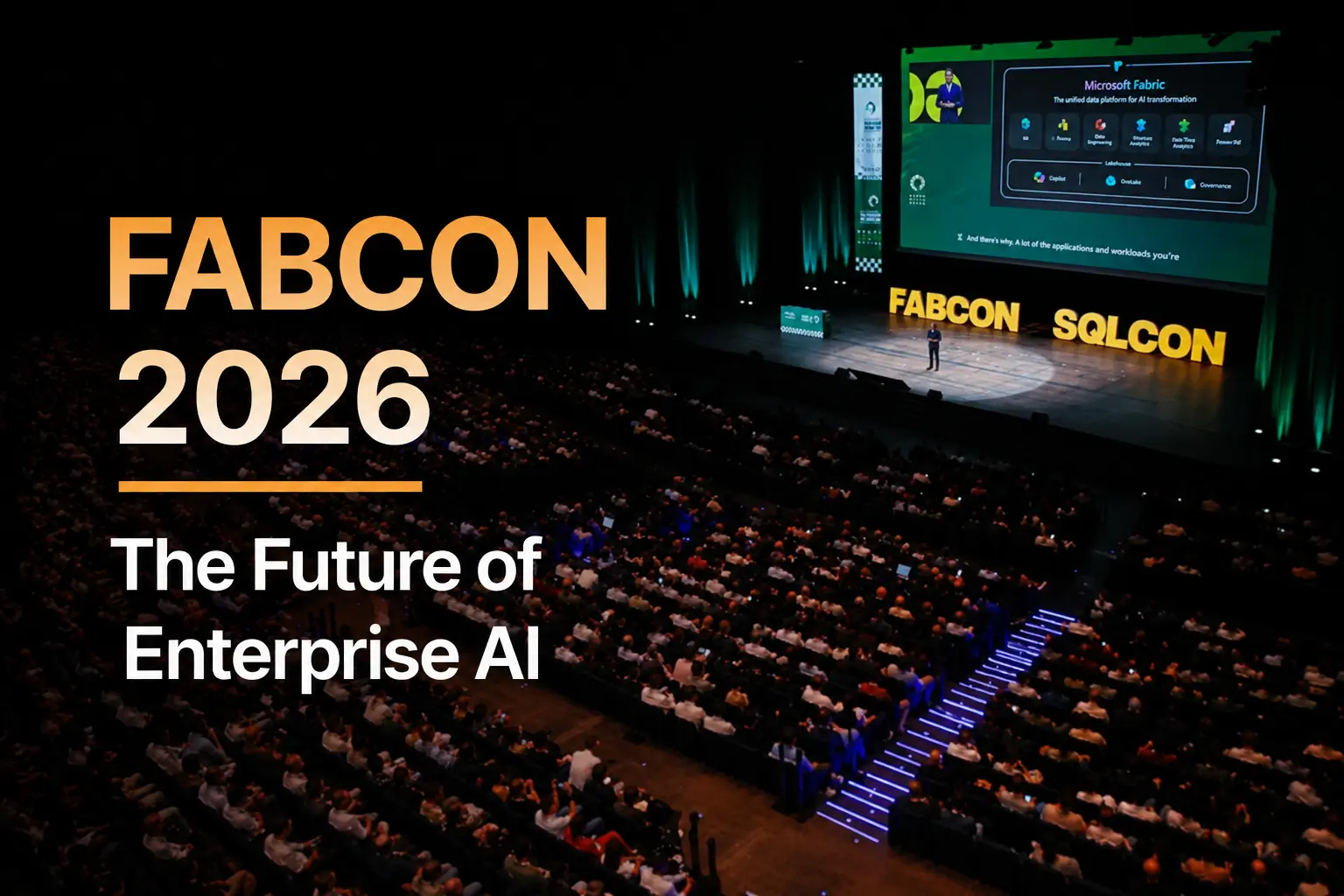
Microsoft’s FabCon Europe and SQLCon 2026 announcements signal a broader shift in how enterprises connect governed data, AI, and operations. For CXOs, the opportunity is to improve decision speed, reporting consistency, and AI adoption while creating a clearer path from experimentation to measurable business value.
Microsoft Fabric is evolving from a unified analytics platform into a governed foundation for data, business context, applications, and AI agents. Fabric IQ can now bring trusted Power BI semantic models and reports into Microsoft Copilot, while Fabric Apps, autonomous data engineering, expanded OneLake capabilities, and platform observability move Fabric closer to the operational core of the enterprise.
For executive teams, the central question is no longer:
Should we invest in another analytics or AI platform?
A more useful question is:
Is our enterprise data sufficiently governed, contextualized, and operationally mature to support AI-assisted decisions and agent-driven workflows?
The answer will shape whether AI improves decisions and operating performance or simply adds another interface to fragmented data.
What Stood Out at FabCon Europe 2026?
Several announcements deserve attention:
- Fabric IQ in Microsoft Copilot Chat and Cowork became generally available.
- Agentic application creation is coming to Power BI.
- Fabric Apps gained capabilities for building governed, production-oriented applications.
- A data engineering agent entered preview for complex, long-running engineering initiatives.
- IQ Sharing entered preview for sharing governed data and business context.
- New OneLake integrations expanded Fabric’s interoperability.
- Fabric observability entered preview.
- On-demand billing and the zero-provisioned F0 model were announced as coming capabilities.
- Database Hub, database agents, and vector-search capabilities expanded the relationship between Fabric and operational databases.
A common thread runs through these updates: trusted context. AI needs more than access to data. It also needs consistent definitions, clear relationships, appropriate permissions, business rules, and current operational signals.
Fabric Is Becoming a Context Layer for Enterprise AI
When enterprise AI falls short, the model is not always the problem. The difficulty often lies in the data and business context surrounding it.
When “revenue,” “active customer,” “qualified lead,” or “available inventory” carries different meanings across departments, an AI assistant can return technically plausible but operationally inconsistent answers. Connecting another model does not resolve that problem.
Fabric IQ is Microsoft’s response to this context gap. It combines the unified data foundation of OneLake, trusted business metrics from Power BI semantic models, and operational context drawn from ontologies and real-time intelligence. Microsoft positions it as a shared intelligence layer that allows people and agents to reason from a common understanding of the business.
Moreover, Fabric IQ is now available in Microsoft Copilot Chat and Cowork. Users can ask business questions grounded in the Power BI reports and semantic models their organizations already use, without additional AI token costs for this Fabric IQ access. Integration with the new Copilot Code experience is planned through Microsoft’s Frontier program.
Power BI Is Moving from Reporting Towards Operational Action
Another notable announcement was the upcoming agentic app-creation experience in Power BI Desktop.
Starting with a trusted semantic model, users will be able to describe an application in natural language, generate it, preview and edit it, and publish it to Microsoft Fabric. Unlike a conventional report, these applications can accept inputs, write data back, retain shared state, and support operational workflows.
Microsoft said the preview would cover Power BI Pro, Premium Per User, and Fabric capacity customers. Power BI Pro and Premium Per User customers are expected to receive access to Fabric Apps and Fabric Database capabilities of up to 1 GB per application at no additional cost for the announced experience.

Fabric Apps Tackles the Difficult Step from Prototype to Production
Fabric Apps aims to close the gap between AI-generated prototypes and production-ready applications. It combines backend functions, managed storage, private access, monitoring, and direct connections to Fabric data sources, while still requiring teams to validate permissions, security, and generated code before deployment.
OneLake Could Simplify a Fragmented Data Estate
OneLake continues to serve as Fabric’s unified data foundation, but the Barcelona announcements expanded its role.
IQ Sharing entered preview, enabling organizations to share governed tables, files, Markdown instructions for agents, and RDF ontologies across teams, customers, partners, and ecosystems. Native support for Fabric IQ ontologies and Power BI semantic models remains on the roadmap.
Microsoft also announced or highlighted:
- General availability of Google BigQuery mirroring
- Preview of bidirectional Salesforce Data Cloud 360 integration
- Deeper Dynamics 365 Business Central integration
- Expanded participation from platforms including Atlan, dbt, and ClickHouse
This gives enterprises a broader choice of architectural patterns, including shortcuts, mirroring, replication, governed sharing, and streaming.
Still, “zero copy” should not become a shortcut for architectural thinking. Teams must continue to evaluate identity propagation, source-system load, latency, residency, ownership, lineage, and where security controls are enforced.
AI Governance Must Cover Decisions and Actions, Not Only Data Access
As Fabric content becomes available to Copilot and agents, the governance boundary expands.
It is no longer enough to ask whether a user can access a table or report. Organizations must also determine whether an AI experience can interpret that information, combine it with other context, recommend an action, or execute an approved operation.
The Barcelona updates reinforced this requirement through developments in OneLake governance, sensitivity and information-protection controls, data-loss-prevention enforcement, Fabric policies, outbound-access protection, and restrictions controlling which semantic models can participate in Copilot experiences.
A practical governance framework should answer five questions:
- Ownership: Who owns each critical business definition?
- Access: Which users, applications, and agents can access the data?
- Interpretation: Which semantic model or ontology is authoritative?
- Action: What may an agent recommend or execute?
- Accountability: How are decisions, approvals, errors, and overrides recorded?
This is the difference between deploying AI features and building an operating model that executives can trust, govern, and defend.
A CXO Agenda for Moving Forward
Executive teams should focus on three priorities: align trusted metrics and business definitions, choose one controlled AI workflow with clear guardrails, and measure success through business outcomes rather than platform activity.
What FabCon 2026 means for Enterprise AI
The event showed that enterprise AI will depend less on adding more tools and more on connecting trusted data, shared business definitions, governed actions, and measurable outcomes. Organizations that strengthen these foundations will be better positioned to turn AI pilots into dependable business systems.
It is that AI needs a more dependable connection to the way the business defines, governs, and uses its data.
Microsoft is positioning Fabric as that connection. OneLake provides the data foundation. Power BI semantic models provide trusted metrics. Fabric IQ adds business meaning and operational context. Fabric Apps and Power BI applications turn insight into workflow. Agents introduce delegated execution. Governance and observability create the controls required to operate the system responsibly.
For CXOs, This Creates Three Immediate Priorities:
- Create one trusted view of the metrics that drive important decisions.
- Define where AI may recommend, where it may act, and where people must approve.
- Track business value, operating cost, reliability, and risk from the beginning.
Organizations that complete this foundational work will be better positioned to move from AI demonstrations to dependable business systems with measurable executive value.
Those that skip it may deploy more copilots but still struggle with inconsistent data, ambiguous answers, duplicated applications, and unmanaged operational risk.
How Intelegain Can Help Turn Fabric into Business Value
Intelegain helps businesses get more value from Microsoft Fabric, from bringing data together and migrating existing systems to building analytics solutions and integrating AI and machine learning. We also help with Power BI, real-time analytics, and data governance, keeping each implementation aligned with the organization’s data needs and business goals.
Whether your organization is assessing Fabric, modernizing an Azure data estate, preparing for Copilot, or exploring governed agents, the first step should be a business-led review. That means connecting the data foundation and security model to the decisions, processes, risks, and outcomes that matter most.
Speak with our team to identify where Fabric can improve decision-making, simplify the data estate, control AI risk, and create measurable business value.


FAQs
The major announcements included Fabric IQ in Microsoft Copilot becoming generally available, agentic application creation coming to Power BI, expanded Fabric Apps capabilities, a data engineering agent in preview, IQ Sharing in preview, new observability features, expanded OneLake integrations, and upcoming on-demand billing with the zero-provisioned F0 model.
Fabric IQ business context in Microsoft Copilot Chat and Cowork is generally available. It can ground AI-assisted responses in trusted Power BI reports and semantic models. Ontologies and some expanded Fabric IQ integrations remain in preview.
Fabric IQ provides governed business context using enterprise data, semantic models, metrics, ontologies, and operational intelligence. Fabric Apps provides an application layer for building secure, data-rich applications connected to Fabric data and services.
Microsoft announced an upcoming agentic app-creation experience in Power BI Desktop. Users will be able to start with a semantic model, describe an application in natural language, edit it, and publish it to Fabric. The announced preview is expected to include Power BI Pro, Premium Per User, and Fabric capacity customers.
The referenced announcements describe F0 and broader on-demand billing as coming soon rather than established production options. Complete pricing had not been published in the reviewed announcement coverage.
Enterprises should assess semantic-model quality, agree on authoritative business metrics, review data and agent permissions, choose one controlled agentic use case, establish observability, and define governance rules for AI-assisted actions.


Build Your Enterprise AI Strategy With Microsoft Fabric