You cannot protect margins if you cannot clearly see where the business is losing time and money. That gets hard when procurement, production, inventory, sales, and finance each run on their own system. One small supply issue can quickly hit production, customer commitments, and costs.
In a slow-growth market, that discipline counts for more. McKinsey’s 2026 State of Food & Beverage puts annual volume growth for CPG companies below 1%. With growth scarce, tighter operations and cost control do the heavy lifting.
For business leaders, choosing the right ERP is much more than an IT upgrade. It is about gaining a clearer view of the business, tightening operational control, and creating a foundation that can support growth without adding unnecessary complexity.
What Is a Food ERP System?
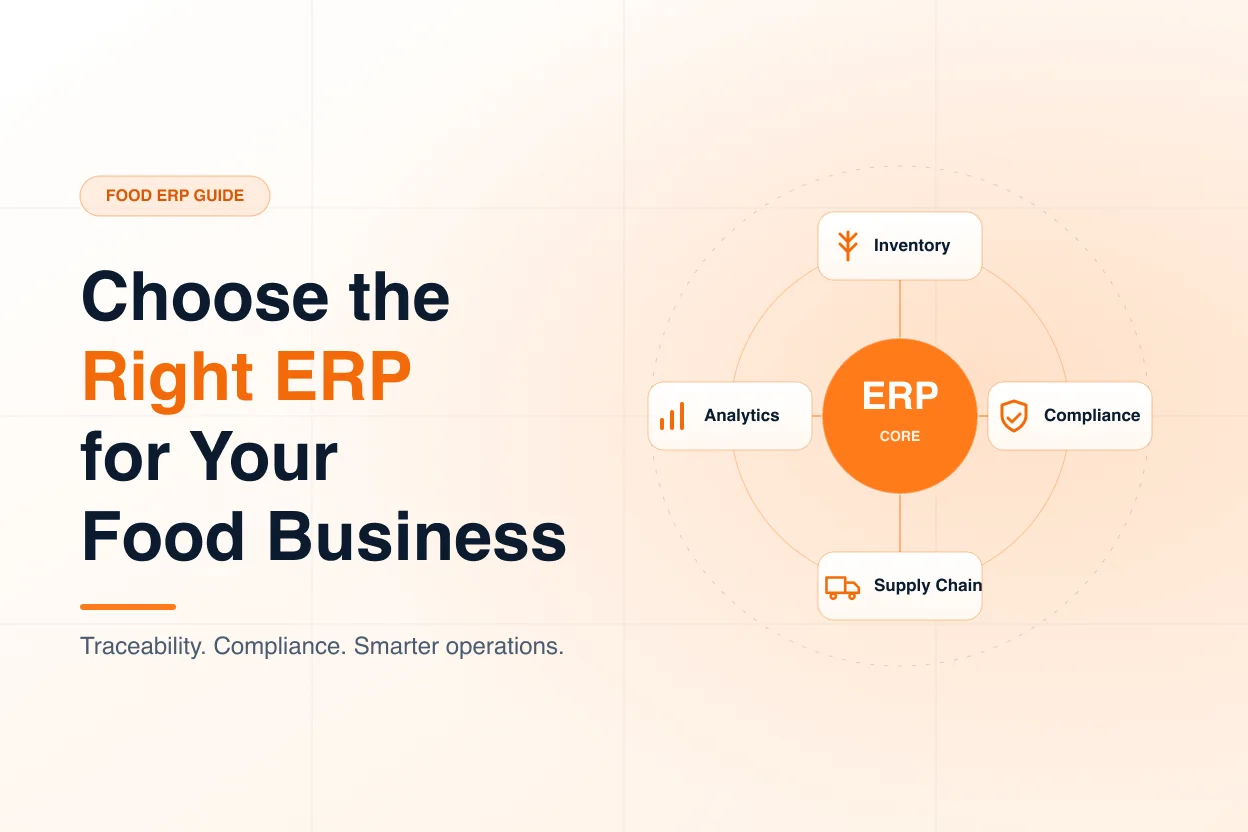
A food ERP system is enterprise resource planning software designed to connect important business functions across a food or beverage company, including purchasing, inventory, production, quality, distribution, and finance. Food-focused ERP systems can also address industry-specific areas such as recipes and formulas and lot traceability.
Why does that matter?
Because these functions rarely operate independently. When demand changes, production may need to adjust. That decision can influence ingredients, purchasing, warehouse activity, customer commitments, and costs. ERP gives those connected processes a common business foundation.
Why Does Food & Beverage Need a Specialized ERP Approach?
Food manufacturers face operational realities that can make a generic system difficult to fit neatly around the business. Recipes and formulations may change. Materials and products can have limited shelf lives. Companies may need to follow lots through production and connect them with quality information. Each of these requirements can influence what gets produced, when it is produced, and how efficiently the company responds when something goes wrong.
The pressure isn’t coming only from inside the factory.
Deloitte’s 2026 Consumer Products Industry Global Outlook found that 47% of consumers surveyed globally were “value seekers,” including 35% of high-income households. Executives surveyed also viewed changing consumer behavior as their biggest challenge to volume growth.
This changes the conversation around ERP for the food & beverage industry. It isn’t simply about putting more processes into one application. It is about creating enough visibility and control to make sound decisions when costs, demand, and operational priorities keep moving.
How Do You Choose the Right ERP for Food and Beverage?
A useful ERP evaluation starts with your business, not a software demonstration. Where does information get stuck today? Which decisions require someone to reconcile spreadsheets or call another department? Which processes become difficult when volumes rise? And what would become a serious constraint if the business added another product line or facility?
Those answers tell you far more about what you need than an enormous checklist of software functions.
Start with the way your business actually works
A beverage producer, bakery, dairy processor, and packaged-food manufacturer may all be shopping for ERP, but their operating models are not interchangeable.
When comparing food and beverage ERP solutions, choose a handful of processes that genuinely matter to your organization and ask each vendor to demonstrate them. If formulas, batch production, shelf-life considerations, or lot-level information are important, see how the platform handles those situations in practice.
VK Industries illustrates why operating-model fit matters. The Indian oilseed processor adopted Microsoft Dynamics 365 Business Central after its custom ERP struggled with increasingly complex requirements. The implementation combined process standardization with industry-specific customizations, automating purchase-to-pay and order-to-cash. The company reported a 50% reduction in data-entry effort. The lesson for ERP buyers is to test their actual manufacturing and commercial workflows, rather than judge a platform by its feature list alone.
One question can keep the evaluation grounded:
How much of our real operating model can this system support without forcing us into costly workarounds?
Get honest about your data
Buying a better ERP does not automatically give you better information.
In PwC’s 2026 Digital Trends in Operations Survey of 767 US operations and supply-chain leaders, 87% said poor data quality had affected their organization’s ability to achieve value from digital initiatives. Meanwhile, 89% said technology investments had not fully delivered the expected results.
That is worth considering before implementation begins.
If product information is inconsistent, integrations are weak, or important processes depend on manual workarounds, moving everything into a new platform may simply relocate the problem. Data readiness deserves a place in the ERP conversation from day one.
Domino’s Pizza UK and Ireland offers a practical example of connected operations. The company replaced legacy, paper-based processes with Microsoft Dynamics 365 Finance and Supply Chain Management. Finance and logistics now operate on a unified platform. Microsoft reports 100% paperless warehouse operations and real-time inventory tracking, alongside automated approvals and stronger financial control. For ERP buyers, the relevant question is how information will flow between departments and support everyday decisions – not simply whether a dashboard is available.
Put traceability to a real-world test
“Lot traceability included” looks reassuring on a requirements sheet. It tells you very little about how well the capability will work for your operation.
Try a scenario instead. Suppose your quality team needs to investigate a specific ingredient lot. How readily can they connect the relevant inventory and production information with the finished goods involved?
Ask every shortlisted provider to walk through a scenario that reflects your business. The differences tend to become much easier to see.
Leave room for the company you want to become
Today’s problems may start the ERP search, but today’s company shouldn’t be the only one involved in the decision.
Think a few moves ahead. A new production facility, broader product portfolio, acquisition, or different distribution model may change how information needs to flow across the organization.
When evaluating ERP software for food industry operations, consider whether the wider architecture can adapt as those needs change.
This is particularly relevant as manufacturing technology evolves. IDC’s discussion of its 2026 Manufacturing FutureScape highlights cloud platforms, data intelligence, and AI among the forces shaping manufacturing’s next phase.
When Maxim’s Group moved its Starbucks business in Southeast Asia off Dynamics AX 2012, it chose Dynamics 365 Finance and Supply Chain Management. The aim was common procurement, inventory, and finance processes across the region. Microsoft points to automated store-order fulfilment, easier transfers, a simpler month-end close, and better teamwork between supply chain and operations. The lesson for ERP selection: test options against a shared operating model across markets, not just one location’s needs.
The goal isn’t to predict every future requirement. It is to avoid making today’s ERP tomorrow’s constraint.
What Does a Food ERP System Really Cost?
The number on a software proposal is only part of the bill.
A realistic business case also needs to account for implementation, integrations, data migration, necessary customization, employee training, ongoing administration, and future changes.
Complexity deserves attention too. A highly customized environment may solve an immediate requirement but become harder to maintain or change later.
PwC’s April 2026 analysis of connected manufacturing describes an emerging approach in which manufacturers keep stable systems of record distinct from faster-changing intelligence layers rather than continually adding analytics and customization to ERP.
For Business leaders, there is a practical message here: Evaluate ERP as part of your technology architecture, not as an isolated purchase.
How Should You Compare Food ERP Vendors?
Don’t let the slickest demonstration win. Give shortlisted providers the same situations and see how their platforms respond. Use a production workflow that matters. Test an important traceability scenario. Discuss the applications that genuinely need to exchange information with the ERP.
Then bring the decision back to five questions: Does it fit the business? Does it help manage risk? Can it work with our technology environment? What will it really cost? Can it scale?
That shifts the conversation from “What can your product do?” to “How would this work here?”
Avoid These Three Expensive ERP Mistakes
Buying before defining the outcome
Be clear about what should improve, whether that’s visibility, process efficiency, data consistency, or the ability to scale.
Digitizing a poor process
New software doesn’t automatically fix unnecessary approvals, awkward handoffs, or duplicate work.
Making ERP an IT-only decision
Technology teams matter enormously, but so do operations, finance, supply chain, and quality. Their processes will live inside, alongside, or downstream of the new environment.
Choose for the Business, Not the Feature List
There is no universal “best” ERP for food and beverage companies. The right choice depends on how your business operates, what information your teams need, where your risks sit, and how you expect the organization to evolve.
So before asking which product has the most functionality, ask a harder question:
Will this technology help us operate a stronger business three years from now, not simply a more digital one today?
How Intelegain Can Help
ERP selection is only one part of modernization. The platform still has to work with existing applications, business data, cloud infrastructure, and the processes employees depend on every day.
That is where planning the surrounding technology environment becomes important.
We help organizations approach transformation across areas such as integration, data, application modernization, and cloud, so that technology decisions can be tied back to practical business requirements.
Our work with HEINEKEN – For HEINEKEN, we built a bilingual customer portal that connects with Dynamics 365 Business Central and Microsoft Dataverse. It brings order placement, real-time inventory visibility, and payment tracking together for more than 1,000 sub-distributors. Our focus was on making these everyday activities easier to manage across the distribution network. It’s a practical example of why an ERP decision needs to consider not just your internal teams, but also the partners who depend on your systems.



Let's Discuss Your Food ERP Requirements