Enterprise growth today is rarely limited by ambition; its potential is hindered by disconnected systems.
Non-integrated systems are silently costing enterprises millions every year, across industries. When data lives in silos – decisions slow down, and opportunities slip away. Visibility without control is just data. Control without visibility is just guesswork. Business leaders today need both, plus they need them in one place.
This article explores how Microsoft Dynamics Business Central eliminates that fragmentation – replacing it with real-time insight, simplified operations, and the kind of decision-making confidence that drives measurable, scalable growth.
The Hidden Cost of Running Your Business on Disconnected Systems
Disconnected processes… may limit operational scalability and responsiveness. — McKinsey & Company
Most enterprise leaders are aware that their systems are fragmented. What fewer have quantified is what that fragmentation actually costs.
Finance runs on one platform. Operations on another. Sales in a CRM that does not communicate with either. Procurement in spreadsheets that someone updates manually every Monday morning. Each system works, in isolation. Together, they create an organisation that is always catching up – never quite operating on a single, reliable version of the truth.
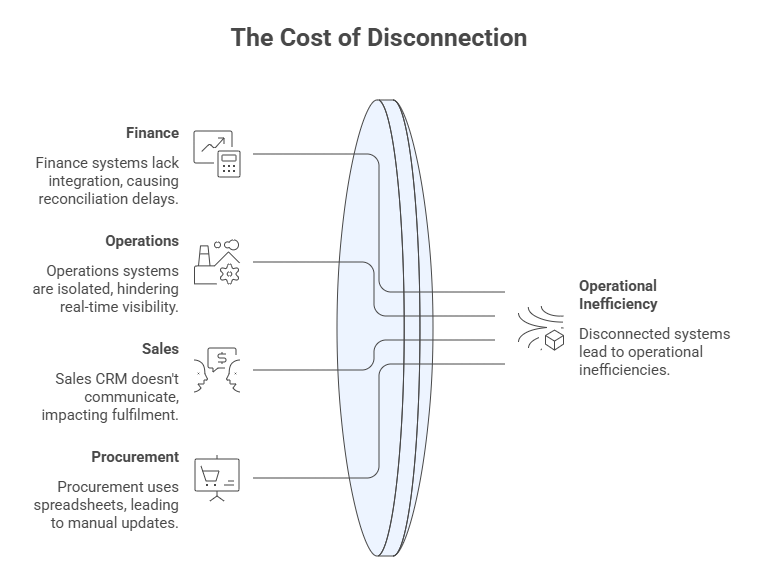
Research is clear, enterprises on disconnected systems spend 25 to 30 percent more time reconciling data than those on unified platforms. Month-end close takes weeks. Inventory decisions lag. Sales commitments outpace actual fulfilment capacity.
But the strategic cost is harder to see and far more damaging. When the CFO cannot trust the numbers, financial planning becomes guesswork. When the COO cannot see operational bottlenecks in real time, efficiency initiatives stall. When leadership is making decisions based on reports assembled from multiple disconnected sources, the margin for error expands precisely when it needs to shrink. This is the problem that Business Central solutions are architecturally designed to solve – not by adding another system to the stack, but by replacing the stack with one.
What Microsoft Dynamics Business Central Actually Does
According to Forrester’s report, organisations achieved a 265% ROI over three years after implementing Business Central. This shows that replacing fragmented systems with a unified ERP delivers significant financial gains and boosts operational efficiency.
Imagine starting Monday morning with every number your business generated over the weekend – accurate, live, and waiting for you. No chasing reports. No reconciling spreadsheets. No wondering if the inventory figure your operations team is working from matches what finance sees.
That is the reality Microsoft Dynamics 365 Business Central creates. One unified platform connecting finance, operations, supply chain, sales, and procurement – in real time, from anywhere, on any device.
When a purchase order is raised, finance sees it instantly. When inventory drops, procurement is notified automatically. When a sales order is confirmed, operations has visibility before the customer hangs up.
Since Business Central is built to integrate with Teams, Outlook, Excel, Power BI, and Microsoft Copilot, it fits right into the tools your employees already rely on daily.
The right Microsoft Dynamics 365 Business central partner does not just implement this system. They make it the operational heartbeat of your entire business.
Business Central Solutions in Action Across Industries
Enterprise Resource Planning (ERP) systems… are often the backbone of a modern enterprise, unifying the organization.— Deloitte
The most persuasive argument for any enterprise platform is not what it promises; instead, it is what it has delivered for organisations operating in conditions that resemble your own. Here is how Business Central solutions are transforming operations across five industries.
Manufacturing
Unreliable inventory data does not just create planning problems – it creates a cascade of them. Business Central eliminates that risk. It does so by connecting shop floor activity, procurement, and finance in real time. Thus, every planning decision is built on data you can actually trust. The impact: reduced unplanned downtime, more reliable delivery commitments, and a substantial cut in inventory expenses.
Wholesale and Distribution
Manual order processing across fragmented systems is a fulfilment risk at scale. Business Central automates the order-to-cash cycle – from purchase order through picking, packing, shipping, and invoicing – with live inventory management ensuring accuracy at every step. Distributors report significant reductions in fulfilment errors and measurable improvements in customer satisfaction scores.
Finance and Professional Services
Manual financial consolidation is one of the most expensive operational processes in professional services firms. Business Central replaces it with automated multi-entity consolidation, real-time reporting, and integrated budgeting and forecasting. Organisations that have made the transition consistently report month-end close accelerating from weeks to days – freeing the finance function to focus on analysis rather than assembly.
Retail
Retail profitability is a margin management challenge. Without a unified view across POS, inventory, and finance, leadership is always making pricing and range decisions on incomplete data. Business Central integrates all three, giving retail leadership a real-time view of margin performance by product, channel, and location – enabling the kind of decisions that protect and grow profitability.
Logistics
Procurement efficiency and supplier relationship management are the two operational levers most logistics businesses underinvest in. Business Central automates procurement workflows, provides supplier performance visibility, and connects purchasing with live operational data – reducing purchase order processing time and giving logistics leadership the supplier intelligence to negotiate from a position of knowledge.
Understanding Microsoft Business Central Pricing And ROI
Microsoft Business Central pricing is almost always the first question in an evaluation conversation, and it deserves a direct answer.
Business Central runs on a simple per-user, per-month model – Essentials for core finance and supply chain, Premium for manufacturing and service management. But the licensing cost is rarely the real conversation.
You should be concerned about what hidden costs your fragmented systems are creating right now. Manual reconciliation. Delayed decisions. Compliance gaps. Legacy infrastructure overhead. Add it up, and the investment looks very different.
Organisations migrating from legacy ERP consistently recover their implementation cost within twelve to eighteen months – through efficiency gains alone.
Here, the question is not what Business Central costs. It is what running without it is costing you every quarter. A strong Microsoft Dynamics 365 Business Central partner will help model that return before the project begins – so the decision is based on evidence, not assumption.
Why Your Dynamics 365 Business Central Partner Matters
Two organisations can implement the same platform, with the same licence, on the same timeline, and arrive at completely different outcomes. The difference is almost never the software. It is the partner.
A great implementation partner does not just configure a system. They map your processes before touching the platform and challenge assumptions about how your organisation operates. They surface inefficiencies that the implementation will either solve or permanently entrench. They manage adoption, not just go-live. And they stay long after launch to ensure the platform evolves as the business does.
The risks of the wrong partner are well documented. Over-customisation that creates technical debt. Systems that go live but never get used. Data migrations that introduce integrity issues nobody catches until weeks later. Conversely, the right one brings industry experience, proven outcomes, and transparency on timelines and pricing – all before the project begins, not after problems surface.
Because the best implementations are not events. They are the foundation of an ongoing partnership – one that grows, adapts, and compounds in value the longer it runs.
Why Choose Us as Business Central Partner
The partner you choose will define how your organisation operates, decides, and scales for years to come. Choose wisely. Intelegain has been that partner for enterprises across industries, and the results speak for themselves.
Microsoft Gold Partner. Recognised, Certified, Trusted. Intelegain holds Microsoft Gold Partner status: one of the most rigorous certifications in the Microsoft ecosystem. This is not a badge. It is a signal that Intelegain has met Microsoft’s highest standards for technical capability, client outcomes, and platform expertise.
Proven Across Industries. Not Just Experience, but Evidence. Intelegain has delivered Business Central solutions for enterprises in manufacturing, logistics, wholesale distribution, finance, retail, pharmaceuticals, and food and beverage.
End-to-End Delivery. From Strategy to Scale. Most implementation partners deliver a go-live. Intelegain delivers a transformation. The entire lifecycle, including design, implementation, and support, is managed by our team. No handoffs. No gaps. Full accountability ensured.
Migration Expertise. Moving from Legacy Without Risk. If your organisation is currently running on NAV, Tally, GP, QuickBooks, Sage, or Xero, Intelegain has a proven, structured migration path to Business Central for each. Migration is where most ERP projects introduce the highest risk, such as data integrity issues, business disruption, configuration errors that surface weeks after go-live. Intelegain’s migration methodology eliminates those risks before they become problems.
AI-Ready and Future-Proof. In 2026, your ERP is your AI foundation. Intelegain’s expertise across Business Central and Agentic AI ensures that when Microsoft’s next wave of automation arrives, your business is already ready for it.
A Partnership Built for the Long Term. Intelegain does not deliver a system and disappear. The relationship continues through ongoing support, platform optimisation, licence management, and strategic guidance as your business evolves.
The move from fragmented to unified starts with a decision, not a technological one, but a leadership one. And that decision starts with the right partner. Contact us, and in one conversation, we will show you exactly where your current systems are costing you the most and how Business Central solves it.

FAQs
Fragmented systems limit visibility across functions, leading to delayed decisions, inconsistent data, and missed opportunities. Over time, this weakens agility and makes it harder to scale efficiently in competitive markets.
Business Central offers a unified, real-time view of operations and financials. This allows leaders to make faster, data-driven decisions with confidence, without relying on delayed or manually reconciled reports.
Leaders can expect improved operational efficiency, reduced costs, faster financial close cycles, and better forecasting accuracy. These outcomes directly contribute to stronger margins and more predictable growth.
By eliminating data silos and automating processes, Business Central reduces errors, improves compliance, and ensures accurate reporting. This minimizes financial risk and strengthens governance across the organization.
Yes, it is designed to scale with your business. It supports increasing data volumes, users, and operational complexity without requiring major system changes or replacements.
It connects finance, operations, sales, and supply chain on a single platform. This ensures all teams work with the same data, improving collaboration and eliminating misalignment across departments.
Find the Best Solution for Your Business Challenges