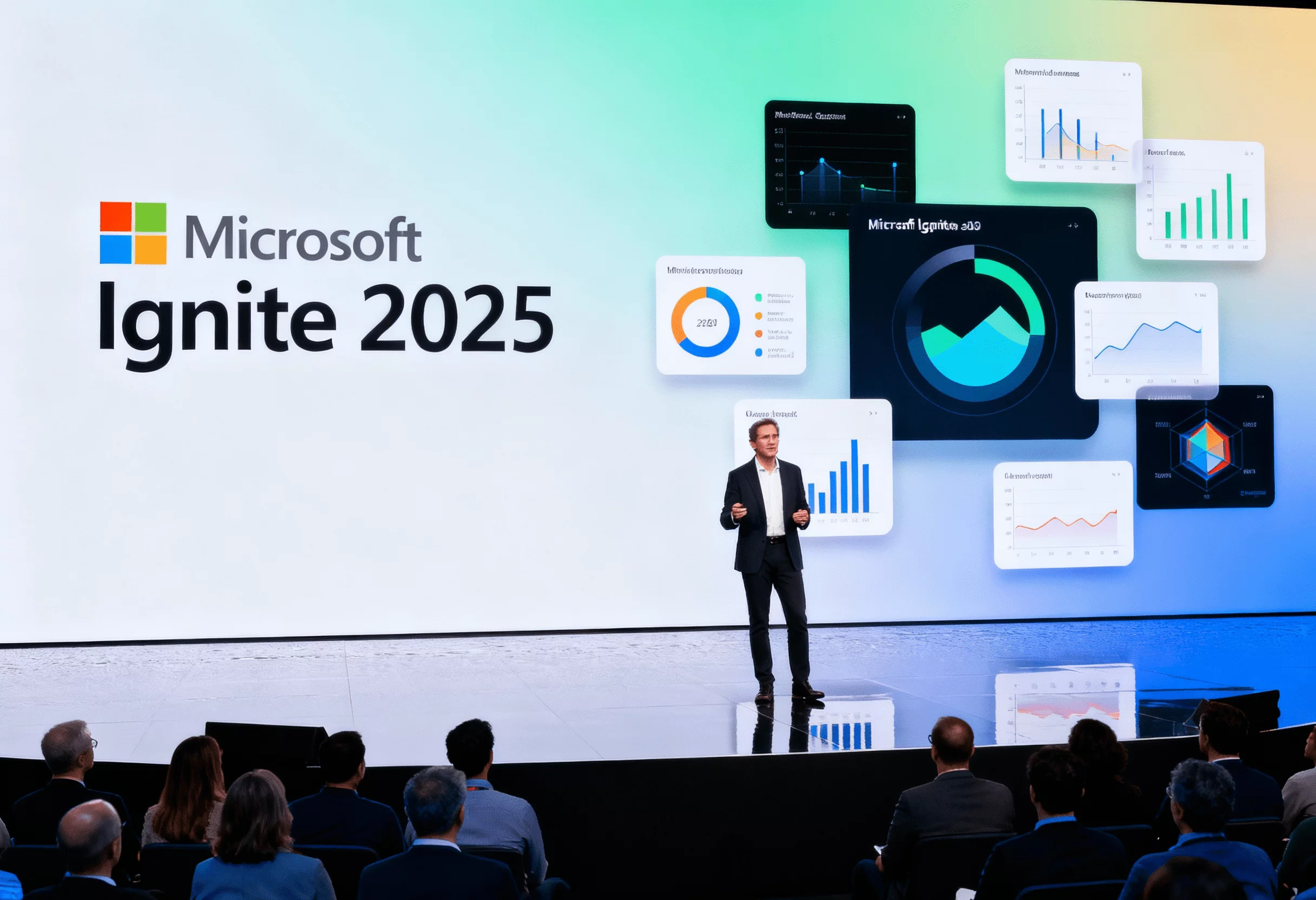
Microsoft’s Ignite conference for IT professionals, developers, and partners took place in San Francisco from 18 to 21 November. This time, CEO Satya Nadella didn’t delivered the opening keynote. That responsibility had been passed to Judson Althoff, the recently appointed CEO of Microsoft’s Commercial business. Nadella, meanwhile was focused on highlighting Microsoft’s expansive AI infrastructure, including its growing network of AI superfactories built on what it calls “fungible fleets.”
As expected, Ignite 2025 was heavily centered on artificial intelligence, with a strong emphasis on AI agents. Ahead of the event’s kickoff on November 18, Microsoft revealed that it is integrating Anthropic’s models into Microsoft Foundry, formerly known as Azure Foundry. With this move, Microsoft positions itself as the only cloud provider offering both Claude and GPT frontier models on a single platform.
Company executives also confirmed that Anthropic’s Claude models will be made available across the Copilot ecosystem, including GitHub Copilot, Microsoft 365 Copilot, and Copilot Studio. As part of the partnership, Microsoft plans to invest up to $5 billion in Anthropic, while Anthropic has committed to purchasing $30 billion worth.
1. Fabric IQ: The Enterprise’s New Semantic Intelligence Layer
Fabric IQ stood out at Ignite as a clear indicator that Microsoft deeply understands both the complexity and the reality of AI adoption in enterprises. Semantics and metadata are no longer treated as background elements. They now form the core organizational layer of the entire data ecosystem, bringing Fabric, Power BI, and AI together through a unified business context.
At its core, Fabric IQ introduces a shared intelligence layer that includes:
- A centralized semantic intelligence foundation
- Well-defined ontologies covering entities, relationships, and definitions
- An evolution of existing Power BI semantic models
- A common business vocabulary used across teams
A contextual layer that enables AI agents and Copilot to operate with accurate business understanding.
For large power BI projects, Fabric IQ introduces a shared intelligence layer that standardizes definitions and governance, reducing rework and confusion.
2. The Convergence of OLTP and OLAP: Fabric Databases Bring Translytical Workloads to Life
One of the most understated yet significant takeaways from Ignite was not a Copilot showcase, but Microsoft’s move to unify operational and analytical workloads through Fabric Databases.
This shift mirrors what is happening across the industry as a whole. Companies such as Snowflake and Databricks, joined now by Microsoft, are steadily removing the divide between transactional and analytical workloads by placing them on the same foundation. It is not being done for buzz or novelty. It is happening because today’s AI-driven use cases and modern analytics cannot function well without direct, consistent access to both operational and analytical data.
Why this matters
Organizations today spend considerable time and resources shuttling data between systems of record (OLTP) and systems of insight (OLAP). This separation introduces multiple challenges, including:
- Increased latency
- Higher infrastructure and data movement costs
- Semantic mismatches across datasets
- Broken or opaque data lineage
- Inconsistent metrics across reports
- A fragile BI layer that repeatedly has to reinterpret operational business logic.
3. MCP and Copilot Transform Semantic Models Into an AI Execution Layer
If Fabric IQ acts as the semantic brain and Fabric Databases provide the operational backbone, the Model Context Protocol (MCP) and the Copilot ecosystem now form the execution layer.
Working together, they elevate Power BI semantic models beyond traditional reporting, turning them into:
- API-like services
- Shared knowledge surfaces across the organization
- Interaction layers for AI agents
- Programmable semantic assets
- Natural language access points for business users.
4. One Lake Becomes the True System of Record
OneLake continued to gain quiet but critical importance at Ignite 2025. Rather than being positioned as just another data lake, Microsoft is clearly treating OneLake as the default system of record for Fabric workloads.
The focus this year was on reducing duplication and confusion across data estates. With deeper shortcut support, cross-tenant access controls, and tighter governance hooks, OneLake is being shaped as a shared foundation that teams can rely on instead of maintaining fragmented storage layers.
For Power BI teams, this means fewer extracts, fewer copies, and far more confidence that reports and AI workloads are operating on the same source of truth.
5. Data Governance Shifts From After thought to Built-In
Governance was no longer framed as something organizations “add later.” At Ignite, Microsoft showed clear progress in embedding governance directly into Fabric workflows. New and expanded controls around cataloging, lineage, sensitivity labels, and access policies were positioned as defaults rather than optional features. This is especially important as AI agents begin to interact with enterprise data. The message was clear: if AI is going to work with business data, governance can no longer sit on the sidelines.
6. Power BI Models Are Now Designed for Reuse, Not Reports
Power BI semantic models were presented less as reporting assets and more as reusable enterprise components. Microsoft emphasized scenarios where a single semantic model can support dashboards, AI agents, Copilot interactions, and downstream applications without being rebuilt each time.
This model-first approach directly benefits long-running power BI projects, where duplicated metrics and inconsistent logic often slow progress and erode trust in analytics outputs.
7. Copilot Grows From Assistant to Daily Operator
Copilot’s role within Power BI and Fabric expanded beyond simple question answering. Ignite demos highlighted how Copilot can participate directly in modeling, exploration, and even refinement of analytics workflows.
Instead of replacing analysts, Copilot is clearly being designed to handle the repetitive and mechanical parts of their work. Tasks like summarizing datasets, identifying trends, or explaining model behavior are now increasingly automated.
This frees up human teams to focus on interpretation and decision-making rather than mechanics.
8. Real-Time Analytics Gets Closer to the Core
Microsoft also pushed real-time analytics further into Fabric’s core experience. Rather than treating streaming and batch analytics as separate domains, Ignite showed tighter integration between real-time ingestion, storage, and visualization.
For Power BI users, this means faster paths from live data to insight, without stitching together multiple tools. It also aligns with the broader theme of collapsing previously separate layers into a single experience. As business decisions become more time-sensitive, this convergence matters more than ever.
9. AI-Ready Metrics Replace Static KPIs
Another subtle but important theme was the move away from static KPIs toward AI-ready metrics. Microsoft highlighted how metrics defined within semantic models can now be consumed consistently by BI reports, Copilot, and AI agents. This reduces ambiguity around definitions and prevents AI systems from “guessing” business logic. In practice, this helps organizations maintain trust in automated insights while scaling AI usage across teams.
10. Fabric Becomes the Default Analytics Stack
Perhaps the biggest takeaway from Ignite was not a single feature, but the direction Microsoft is heading. Fabric is no longer positioned as an optional platform for certain teams. It is increasingly presented as the default analytics stack for the Microsoft ecosystem.
Power BI, OneLake, Fabric Databases, Copilot, and governance services are being designed to work best when used together. Over time, this tight integration may make it harder to treat analytics, AI, and data as separate initiatives. Ignite 2025 made it clear that Microsoft sees them as one interconnected system.
Conclusion
Ignite 2025 made it clear that Microsoft is shifting away from fragmented innovation toward a more connected analytics ecosystem. Rather than showcasing isolated features, the focus was on tightening the links between data, semantics, AI, and governance. Power BI is no longer positioned as just a reporting layer, and Fabric is no longer optional. Together, they are being shaped as a shared foundation where analytics, operational data, and AI activity coexist instead of competing for space.
What stood out was the intent behind these changes. Semantic models are treated as reusable assets, governance is built into everyday workflows, and AI is expected to work with business context rather than around it. The updates may appear gradual, but taken together, they reflect a clear strategy. Microsoft is aligning its analytics stack to function as a single system, one designed for scale, consistency, and real-world enterprise use rather than experimentation alone. Seen together, these updates show how Power BI services help organizations move from isolated dashboards to a consistent analytics system built for scale and real-world use rather than experimentation alone.

Get Expert Guidance on Power BI & Fabric Innovations